Introduction
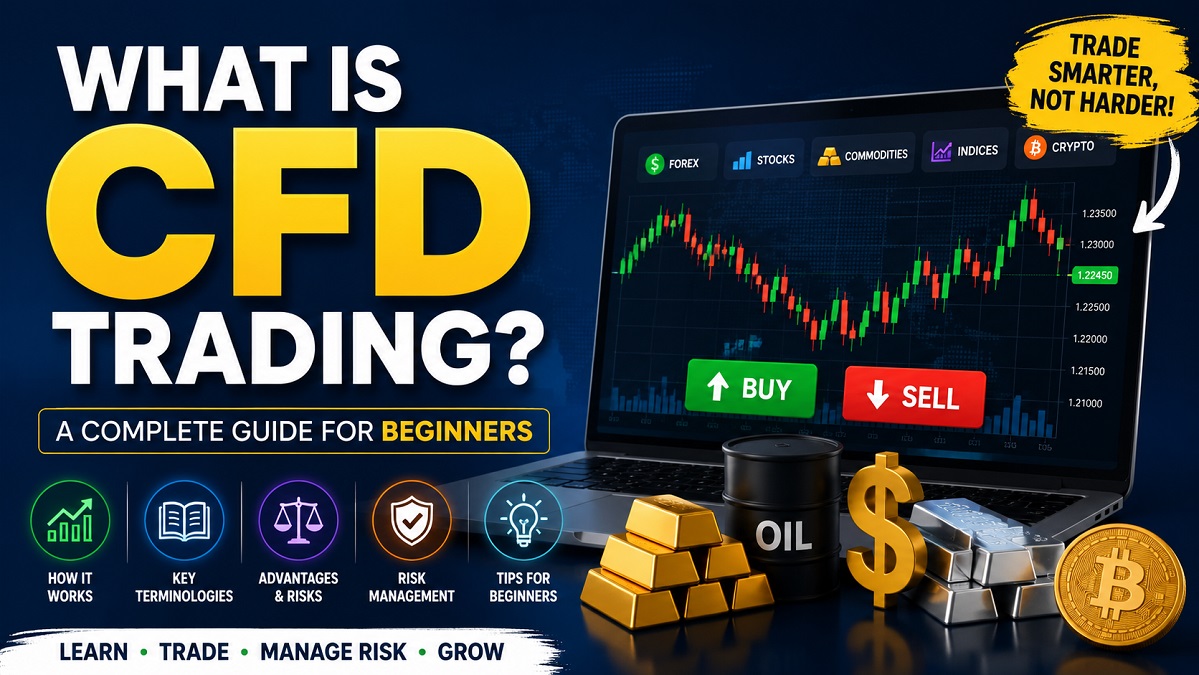
Over the past few years, trading Contracts for Difference (CFDs) have emerged as a convenient way for traders to access global financial markets without needing to buy assets. CFDs let traders offer a bid on the direction of price changes in all markets: forex, equities, commodities, indices, and even crypto.
CFD trading is risky and often causes new traders to make excessive trading mistakes that cost money. This guide provides needed baseline knowledge on CFD trading. First, we provide what CFDs are, the pros and cons, and the essential trading jargon.
What are CFD’s?
CFD stands for Contracts for Difference. This is an agreement to trade with a broker and allows the trader to bid on the direction of an asset’s price without needing to own it.
In brief, if a price shifts to the direction that you bid:
- You make money
- If the price shifts in the opposite direction, you lose money
The gain or loss is determined by the price at which the trade is closed minus the price at which the trade was opened.
Example of CFD Trading
Consider:
- Gold Price = $4,300 per ounce
- Belief = Gold price will increase
- CFD Position = Open a “Buy” Position
If Gold Price = $4,350:
- You Earn = Close Price - Open Price
If Gold Price = $4,250:
- You Lose = Close Price - Open Price
CFDs allow you trade gold price , without actually owning gold.
How CFD Trading Works
CFD trading is done through brokers who provide you access to trade financial markets. In the market, you can place a position on:
- Forex
- Stocks
- Commodities
- Indices
- Cryptos
- Metals
- Energies
The broker offers you leverage to trade bigger position with a less capital.
Two Directions in CFD Trading
1. Buy Position (Long Position): You believe the price will increase, then you "buy".
2. Sell Position (Short Position): You believe the price will decrease, then you "sell".
One of the advantages of CFD trading is that you have the opportunity to earn on both bull and bear markets.
Common Markets of CFD Trading
Forex Pairs CFDs
Trading of currency pairs such as:
- EUR/USD
- GBP/USD
- USD/JPY
PSX (Pakistan Stock Exchange) Stocks CFDs
Speculation on equities.
Examples:
- MLCF - Maple Leaf Cement Factory Ltd.
- TPL - TPL Corp. Ltd.
- KEL - K-Electric Ltd.
- PTC - Pakistan Telecommunication
- FNEL - First National Equities Ltd.
Commodity CFDs
Trading commodities like:
- XAUUSD - Gold
- XAGUSD - Silver
- XBRUSD - Brent Oil
- XCUUSD - Copper
- XNGUSD - Natural Gas
Index CFDs
Trading market indices such as:
- KSE100 - KSE 100 Index
- KSEALL - KSE All Share Index
- KMIALL - All Islamic Shares Index
- BKTI - Banking Tradeable Index
- OGTI - Oil and Gas Tradeable Index
Cryptocurrency CFDs
Trading digital currencies like:
- BTC/USDT - Bitcoin
- ETH/USDT - Ethereum
- XRP/USDT - Ripple
How To Get Started With CFD Trading
Trading terminology is important to understand before getting started with CFD Trading.
1. Leverage: Leverage allows the trader to place big trades with a small amount of money.
Example:
- 1:100 leverage means you can control $10,000 with only $100.
Advantages
- Larger positions can be opened
- Larger profits can be made
Disadvantages
- Larger losses are possible
2. Margin: Margin is the amount that is required in order to open a leveraged position. There are two different types of margin.
- Initial Margin: This is the amount that is required to open the trade.
- Maintenance Margin: This is the amount that is required to be maintained in the account in order to keep the trade open.
3. Spread: The spread is the difference between the Buy price (Ask) and the Sell price (Bid).
This is typically one of the main sources of income for a broker.
Example:
- EUR/USD Buy = 1.1050
- EUR/USD Sell = 1.1048
- Spread = 2 pips
4. Pip: A pip is the smallest price change in a currency pair.
Example:
If EUR/USD moves from:
1.1000 → 1.1005
The movement is equal to 5 pips.
5. Lot Size: A lot is a size of a trade.
Common Types of Lot Sizes
Lot Type Units
Standard Lot 100,000
Mini Lot 10,000
Micro Lot 1,000
6. Bull Market: A market is defined as Bull Market when prices are continuously increasing. In bullish markets, traders typically prefer buy positions.
7. Bear Market: This term indicates the overall decline in the market price. Traders mostly opt for short selling in these kinds of markets.
8. Stop Loss: To avoid triggering larger trades and incurring bigger losses, a stop loss is set to close the trade automatically.
Example
If you purchase gold at $4,300, you may set stop loss as per your holding capacity like 0.5% - 2%. This stop loss ensures traders incur minimal loss.
9. Take Profit: A take profit order is set to automatically sell the trade and close the position at the profit target.
Example:
If you purchase gold at at $4,300, you may set profit target like 0.5% - 5%. Once the price hits your target the profit order automatically executes.
10. Volatility: Volatility is the rapid movement of prices in the market.
High volatility presents:
- An uptick in trading opportunities
- An uptick in risks
11. Liquidity: This describes the ease at which the asset can be bought or sold.
Major forex pairs, gold, and large cap stocks are examples of a highly liquid market.
12. Slippage: This is the variance in the expected price of a trade and trade execution price.
13. Overnight Fees (Swap Fees): Some CFD brokers apply fees for trades held overnight.
14. Margin Call: This is a request for more funds if the balance is below the required margin. The broker has the ability to close trades if funds are not added.
15. Hedging: Hedging is a strategy that involves taking inverse positions in order to minimize trading risks.
Advantages of CFD Trading
- Access to Global Markets: With CFD trading, you can access multiple financial markets.
- Leverage Opportunities: Minimal investments can control larger trades.
- Profit in Rising and Falling Markets: Traders can either opt to go long or short the market.
- No Physical Ownership: You don't acquire any assets, but trade the price variation.
- Lower Capital Requirement: CFDs require less funds for trading than other forms of investing.
Risks of CFD Trading
- High Risk Due to Leverage: Leverage can worsen the size of the loss.
- Market Volatility: Markets moving unexpectedly can lead to losses.
- Emotional Trading: Traders can act irrationally during anger and pleas to sell or buy.
- Overnight Charges: Keeping a trade open longer can incur higher costs.
- Lack of Proper Knowledge: Uninformed beginners can have poor trading habits.
Basic Strategies Used in CFD Trading
- Trend Trading: Trading in the given direction of the market.
- Scalping: Capitalizing on the smaller price changes.
- Swing Trading: Positioning for longer to profit the larger price movements.
- Day Trading: Opening and closing trades during the day.
Risk Management in CFD Trading
Risk management is prioritized by the successful traders.
Important Practices: (a) Use Stop Loss (b) Don't Over-leverage
Only low capital amounts should be risked.
Keep to your trading plan Don't trade based on feelings
Is CFD Trading Halal or Haram?
CFD trading can be allowed or disallowed depending on:
- The type of leverage: If there are interest changes (swaps) or not,
- The speculative nature of the trading: The regulating policies of the brokers
Some traders want to have Islamic accounts as they have no interest charge accounts.
If you are undecided, checking with a qualified Islamic finance scholar may be a good decision.
Who Should Consider CFD Trading?
You might want to consider CFD trading if you’re one of the following:
- Active Traders
- Short-Term Market Participants
- Seasoned Investors
- Traders that Understand Market Risk
Those looking for zero-risk opportunities or guaranteed profit trades likely shouldn’t consider CFD trading.
Beginner CFD Trading Recommendations
Open a Practice Account
You’ll learn how to trade without the chance of losing any of your own money, become familiar with Technical Analysis, and learn how to read trends, charts, and indicators is invaluable.
Know the Risks
- Roadblocks to execution are often due to the need to protect capital. Before pursuing profit, consider preserving capital.
- Resist the Urge to Trade
- Too many trades often lead to poor execution.
- Select the Right Broker
Choose a CFD Broker in a Regulated Market
Traders understand that the best CFD brokers create fast and safe trading platforms that grant effortless access to the global financial markets. To protect user and client data and financial resources, these brokers employ fast encryption and advanced systems. Rapid execution enables traders to respond to changing conditions in the market with heightened efficiency and minimizes lag. Time-sensitive features available to all traders on CFD brokers' platforms include the real-time availability of charts, technical analysis tools, and mobile trading access. Trusted brokers include affordable spreads, clear pricing, and professional customer support, which further enhances the positive experiences of new and expert traders. More traders should trade CFDs as a result.
Our recommended exchange and brokers:
1. Pakistan Mercantile Exchange (PMEX)
SUMMARY
Trading CFDs is potentially one of the most flexible ways to trade on the financial markets, providing the opportunity to trade with leverage. Traders are able to trade not only in the ever shifting direction of forex and stocks, but also in commodities and cryptocurrencies.
Trading CFDs is one of the most aggressive and higher risk forms of trading available. It is important to understand the discipline of trading and associated risks. Because trading requires specific terminology such as Margin, Pips, Spread, Stop Loss, Volatility, etc., new traders are required to do their research.
New traders are encouraged to take the slow approach and focus on the education of trading over attempting to generate profits first.
Rate Blog
Tap a star to rate this guide. Ratings are open for everyone and are counted immediately.