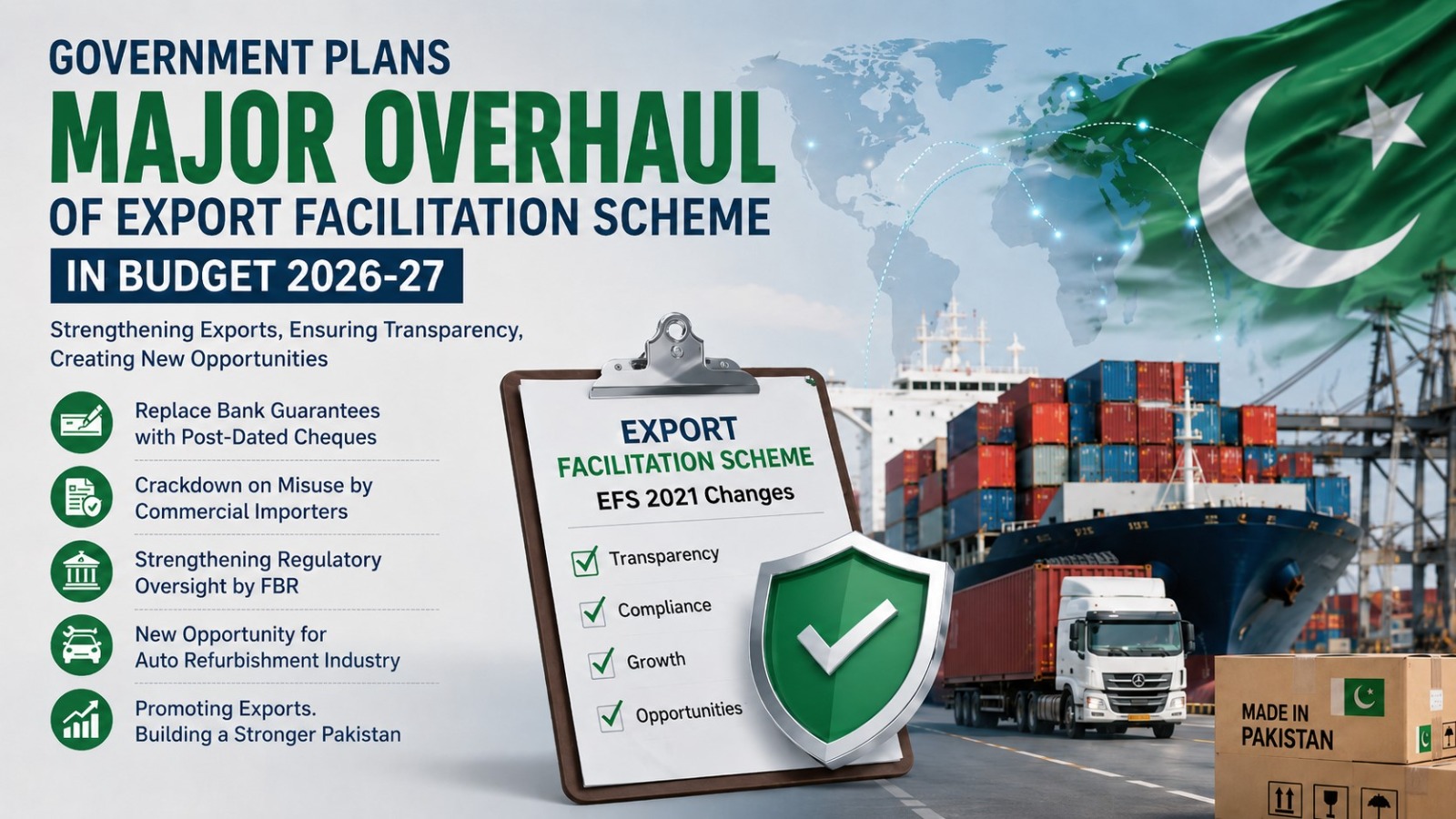
Government Plans Major Overhaul of Export Facilitation Scheme in Budget 2026-27
There may be important policy shifts for Pakistan's export sector in the Federal Budget 2026-27 with proposed changes in the Export Facilitation Scheme (EFS) 2021, as the government is opting for changes in the EFS 2021. The proposed changes are targeting the malpractices of export incentives, and are targeting the improvement of malpractices as well as the transparency and practices of export-oriented businesses.
After consultations with stakeholders, the Federal Board of Revenue (FBR) put the finishing touches on a set of recommendations, many of which will change how importers and exporters will be able to use the scheme in the future.
What Is the Export Facilitation Scheme (EFS)?
The Export Facilitation Scheme (EFS) allows companies to import raw materials and production inputs without paying customs duties and taxes in advance if the inputs are used to produce goods that will be exported. To improve the potential of Pakistan's exports, the scheme reduces costs related to exports and increases the cash flow of the exporters. Since the introduction of the scheme in 2021, the number of issued Export Facilitation Scheme (EFS) licenses has almost doubled, and this trend shows that this scheme is becoming crucial to Pakistan's export industry.
Key Proposed Amendments to EFS
1. Replacing Bank Guarantees with Post-Dated Cheques
It is more attractive to think about post-dated checks, under EFS, offering financial integrity for postponed duties and taxes, as substituting bank guarantees. This would reduce both the costs of exports and the burden on exporters while still providing safeguards for government revenue.
2. Crackdown on Misuse by Commercial Importers
The government is also looking to implement measures to limit the potential for Commercial Importers to take advantage of the EFS by misusing sales tax invoices. It is the opinion of authorities that some importers are benefiting from instruments that are designed to be used strictly by exporters.
As a first step in addressing the concerns, the proposal for EFS will include the withdrawal of the current provision that permits Commercial Importers to sell their sales tax invoices within the domestic market.
3. Strengthening Regulatory Oversight
The proposed changes to EFS will also include the FBR’s framework of customs control and the enhancement of regulatory powers for the oversight EFS. These changes will be implemented with the intention of enforcing compliance and limiting the potential for misuse of the scheme while retaining the advantages for exporters.
New Opportunity for the Auto Refurbishment Industry
One of the new proposals is to allow the temporary importation of used vehicles and automobile parts for the sole purpose of repair, restoration, or refurbishment, and were to be exported again. Currently, such imports are primarily prohibited under the current trade regulations.
Within the new model:
- Service providers with verified repair and refurbishment systems may be provided the option to temporarily import used vehicles.
- Used automobile parts may be imported for refurbishment and then be exported again.
- Businesses ought to be registered under EFS and meet trade requirement regulations.
- Annual Reconciliation Statements will be expected.
- Refurbished vehicle and/or parts will not be allowed for sale in the local market under any circumstances.
If this is approved, this will potentially tap into a new segment of the trade of Pakistan’s Automotive Industry, while gaining other Foreign Exchange.
Why the Government Is Tightening the Scheme
For several years, authorities have been aiming to strengthen trade mechanisms of the EFS. Previous amendments have provided for stricter compliance, reconciliation reporting, and tighter monitoring of duty exemptions and trade restrictions. The main objective of the amendments has been to ensure that the duty exemptions and tax concessions are used for the intended purposes of enhancing exports instead of facilitating local trading.
The expectation of the government is that with improved trade mechanisms of the EFS, the value added trade and exports will be positively impacted.
- Potential Impact on Exporters
- Positive Impacts
Outcomes
- Greater accountability and transparency
- Reduced financial burden from the removal of bank guarantees
- Better safeguards for genuine exporters’ incentives
- More opportunities for exports of vehicle and auto parts refurbishment
- Greater confidence for international customers and investors
Potential Problems
- More compliance and reporting requirements
- Costs to businesses adjusting from the current methods of doing business
- More examination of the transactions in the scheme
What Exporters Should Do
Export-oriented businesses should keep an eye on the announcements in the upcoming federal budget and assess their compliance. For businesses utilizing EFS, it is important to have the correct documentation, tracking of inventory, and procedures for reconciliations to prevent disruptions once the new framework is in place.
For businesses looking at the new vehicle refurbishment program, the proposed changes in the budget may bring new business opportunities in this area, if the changes get approved.
SUMMARY
The proposed changes to the Export Facilitation Scheme are a signal that the government is trying to balance facilitating exports and limiting the misuse of tax incentives. By implementing additional controls and opportunities for exports, it is an effort to enhance Pakistan’s exports and economic growth.
If the new EFS achieves the purpose, it may bring a competitive and sustainable export environment for businesses in Pakistan in the future.

Rate Blog
Tap a star to rate this guide. Ratings are open for everyone and are counted immediately.