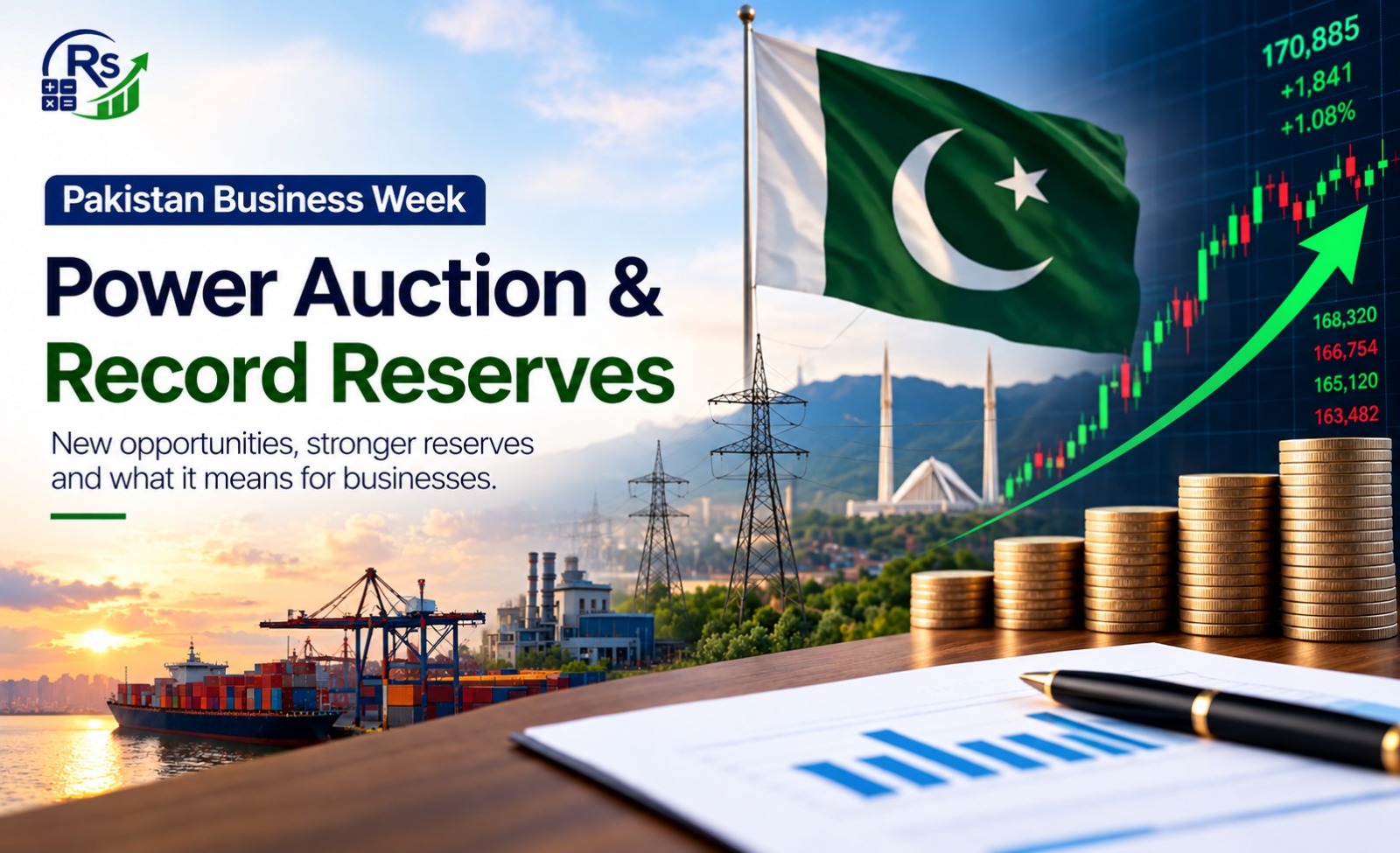
If you’ve been following Pakistan business week, the country feels like it’s standing in two rooms at once. In one room, officials are highlighting historic SBP reserves, the country’s first electricity wheeling auction, and a stock market that keeps finding buyers. In the other, factory owners, pump dealers, and millers are still grappling with fuel costs, wheat prices, and the everyday expense of keeping the lights on.
The Big Commercial Shift: Electricity Is No Longer Only A Government Product
The week’s most consequential business move was not a rate cut or a listing. It was the Independent System and Market Operator issuing a request for proposals for Pakistan’s first 400 MW wheeling auction under the Competitive Trading Bilateral Contract Market.
In plain language: large users, mainly industrial consumers above 1 MW, will be able to buy power from a supplier of their choice and have it delivered over the national grid. The government says it is stepping back from being the single buyer. Bids are due by 20 November, with 400 MW on offer now and 800 MW planned over five years.
For manufacturers, this is the first practical crack in a system that has long meant one tariff, one DISCO, and little bargaining power. Whether it actually lowers industrial power costs will depend on use-of-system charges, who wins the auction, and how quickly the market expands beyond a few hundred megawatts. The intent, though is clear competition instead of central procurement.
That reform sits next to an older headache. Circular debt in power and gas is still on the table as Pakistan prepares for the IMF’s fourth review, with DISCO privatisation and tariff design expected to dominate talks. A new market will not, by itself, retire that Pakistan stock exchange. It can, if it works, stop adding as much of it.
Reserves Look Strong. The Street Still Feels The Middle East.
On paper, the external buffer is the best official slice Pakistan has posted. SBP reserves jumped after Eurobond proceeds landed, reaching about $21.4 billion for the week ended 11 September. Total liquid reserves were near $26.8 billion, and import cover crossed the three-month mark again.
That is a real achievement. It is also not the same thing as cheap energy. Petroleum Minister Ali Pervaiz Malik warned that a shortage could push petrol toward Rs 1,000 a litre, after prices had already risen sharply on global volatility. Oil companies have been pressing OGRA on margins. Chambers have called austerity an “economic curfew” while the petroleum levy still sits heavily in the pump price.
So the commercial mood is split. Banks and the finance ministry can point to reserves, a Eurobond that found buyers, and talks about a China swap-line extension plus possible U.S. financing. Shopkeepers and transporters still live in a world of early mall closures, freight risk in the Gulf, and fuel that moves with every headline from the Middle East.
PSX: Buyers Are Back, But Oil Still Sets The Tempo
Equities spent the week doing what Pakistani markets do when geopolitics and crude wrestle with value they swung, then recovered. The KSE-100 closed Friday near 170,885 after a 1,841-point bounce as oil eased and traders priced in a chance of cooler U.S.–Iran tension. Monday opened with more buying.
Banks, Cement, Fertilizer, and E&P names did the heavy lifting. That is a familiar leadership mix when liquidity is decent and the index is hunting for a floor after a volatile stretch.
It is not a carefree bull market. Last week’s net gain was modest once you look through the noise. Investors are still treating oil, shipping, and the next IMF conversation as the real risk committee.
Quiet Positives On The Factory Floor
A few sector notes that matter if you run a business rather than a portfolio:
Cotton arrivals were up about 19 percent to 2.4 million bales by mid-September, with Punjab leading the jump. Textile exports grew just over 5.5 percent in July–August even as the oil import bill rose. That is not a boom. It is a reminder that the export machine still turns when fiber is available.
Auto loans have now risen for a 21st month. BYD is lining up local assembly of the Sealion 6 from the fourth quarter. Suzuki has started exporting Pakistan-made Alto units to Brunei. The auto show wrapped with new tractor models as well. Demand is selective, but the assembly story is not dead.
SECP also approved Shariah-compliant digital financing of up to Rs 3 million for small businesses through the Shamika Tajir app, aimed at inventory from approved suppliers. NBFCs already put about Rs 253 billion into small-business loans last year. If the onboarding is clean, this is more useful to a Kiyana or workshop than another speech about “financial inclusion.”
Wheat is the sour note. TCP is tendering for imports, and millers in Punjab have talked strike. Private traders want more import space so share prices
do not spike. Food inflation is still the channel through which a “stable” macro story can lose the public in a week.
What This Week Actually Means For Business
Stabilization is no longer the debate. FY26 growth came in around 3.7 percent. The fiscal deficit narrowed. Reserves are thicker. The argument has moved to whether that stability becomes cheaper energy, cheaper working capital, and a market that industrial users can actually use.
Three things to watch into October:
1. Who bids in the 400 MW wheeling auction, and at what delivered price after grid charges.
2. Whether the IMF review locks a credible path on power and gas circular debt without another blunt tariff shock.
3. Whether Gulf shipping and crude stay orderly enough that pump prices and factory fuel costs stop dominating every chamber meeting.
Pakistan does not need another slogan about turning the corner. It needs industrial power that can be contracted, fuel that does not lurch on every tanker scare, and credit that reaches the firms already hiring. This week offered a first real market opening on electricity, a record official reserve number, and a stock market willing to buy dips. The commercial test is whether those headlines show up as lower costs on a factory invoice before the next shock arrives.



Rate Blog
Tap a star to rate this guide. Ratings are open for everyone and are counted immediately.